



Light Adjustable Lenses (LAL)

What Is The Light Adjustable Lens?
The Light Adjustable Lens™ (LAL®) by RxSight® is the only FDA-approved intraocular lens (IOL) that can be customized after cataract surgery.
With a traditional fixed lens, your surgeon chooses the lens power from measurements taken before surgery. That works well for most patients, but the eye can heal in ways measurements can’t fully predict. If your vision isn’t quite where you want it, options to change a fixed lens are limited.
The LAL is made of a special light-sensitive material. After your eye heals, our team uses a precise UV light treatment in the office to reshape the lens and fine-tune your prescription. You see the result in everyday life before it is locked in. Compare all of your choices on our lens options page.
Fixed Lens vs. Light Adjustable Lens
The surgery itself is the same cataract procedure we already perform. The difference is what happens in the weeks after.
| Traditional Fixed IOL | Light Adjustable Lens | |
|---|---|---|
| When your prescription is set | Before surgery, from measurements | After your eye heals, based on how you actually see |
| Preview your vision? | No | Yes, before it is finalized |
| Leftover astigmatism or blur | Glasses, contacts, or another procedure | Adjusted in-office with light treatments |
| The surgery | Standard cataract surgery | The same standard cataract surgery |

How The Light Adjustable Lens Works
- Consultation. We examine your eyes, take detailed measurements, and talk through how you use your vision day to day: driving, reading, screens, and hobbies.
- Cataract surgery. Your surgeon removes the cataract and places the LAL, just as with any lens implant. You start wearing UV-protective glasses right away.
- Healing. Your eye settles over the next few weeks while you keep wearing your UV-protective glasses during waking hours.
- Light adjustments. Once you’ve healed, you come in for short, painless light treatments that reshape the lens. Between treatments, you live with your new vision and tell us what you’d change.
- Lock-in. When you’re happy with your vision, a final light treatment locks in your results. After that, the UV glasses come off for good.

Benefits Of The Light Adjustable Lens
*Based on a prospective, randomized, multicenter FDA study of 600 patients comparing the LAL to a commercially available monofocal IOL. Individual results vary.
Is The Light Adjustable Lens Right For You?
The LAL is FDA-approved for adults who need cataract surgery, have at least 0.75 diopters of corneal astigmatism before surgery, and do not have pre-existing macular disease. You may be a strong candidate if you:
The LAL may not be recommended if you take medications that increase sensitivity to UV light, have a history of ocular herpes simplex, have nystagmus, or have certain other eye conditions. Your surgeon will confirm whether the LAL is a good fit at your consultation.

What to expect during your Light Adjustable Lens treatment:
Timeline:
Light treatments typically begin a few weeks after surgery, once your eye has healed. Most patients need a small series of treatments over several weeks, followed by a final lock-in treatment. Your surgeon will set your exact schedule.
Light Treatments:
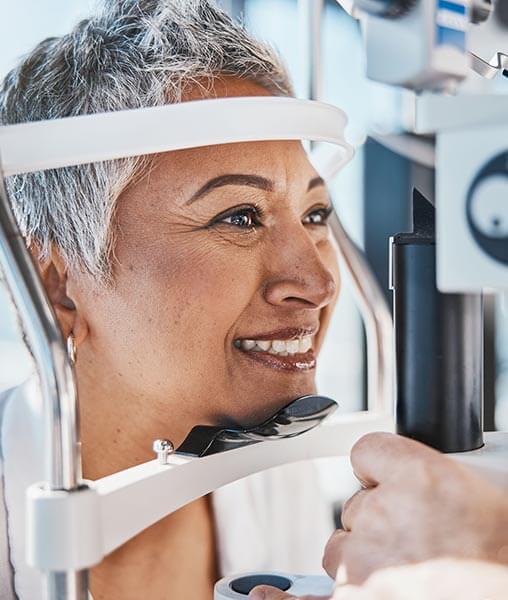
Your eye is dilated, and you sit at a device similar to the microscope used in a routine eye exam. Each treatment is painless and takes only a few minutes. Many patients notice the change in their vision within about a day.
UV-Protective Glasses:
From surgery until your final lock-in treatment, you’ll wear special UV-protective glasses during all waking hours, indoors and out. Unprotected UV exposure can change the lens in ways we can’t control. Once results are locked in, you no longer need them.

After Your Results Are Locked In
Your adjusted lens is permanent, just like any other lens implant. It will not cloud the way your natural lens did, and you’ll return for routine follow-up care with our team.
Cost And Coverage
The LAL is a premium lens. Medicare and most insurance plans cover standard cataract surgery, and there is an additional out-of-pocket cost for the LAL and its adjustment visits. We’ll give you a clear quote at your consultation and can review financing options.
Why Choose Center For Eye Care Excellence For The Light Adjustable Lens
Decades of cataract experience. Our surgeons have performed cataract surgery for decades and bring that experience to every LAL case.
Precision at every step. We pair the LAL with advanced tools like ORA intraoperative measurement and laser-assisted cataract surgery where appropriate.
Cornea expertise. As a practice rooted in cornea care, we’re well equipped to evaluate patients with prior refractive surgery or complex corneas.
One team, start to finish. Your consultation, surgery, and every light adjustment happen with the same team at our Slingerlands office.

Light Adjustable Lens Patient Testimonial
Light Adjustable Lens FAQs
Important Safety Information
The Light Adjustable Lens and Light Delivery Device system is approved for patients who have a cataract and need surgery, have at least 0.75 diopters of corneal astigmatism before surgery, and do not have pre-existing macular disease. The LAL is not recommended for patients taking systemic medications that increase UV sensitivity or are toxic to the retina, patients with a history of ocular herpes simplex, or patients with nystagmus. Unprotected UV exposure before the final lock-in treatment can cause unpredictable changes to the lens and blurred vision, and may require lens removal. Safety and effectiveness have not been established in patients with certain pre-existing eye conditions or intraoperative complications.
Light Adjustable Lens, LAL, and RxSight are trademarks of RxSight, Inc.